Plain-language practice pages explain the questions to discuss with counsel.
DeBacco / Mancinetti · Independent redesign
An identity built
from the record.
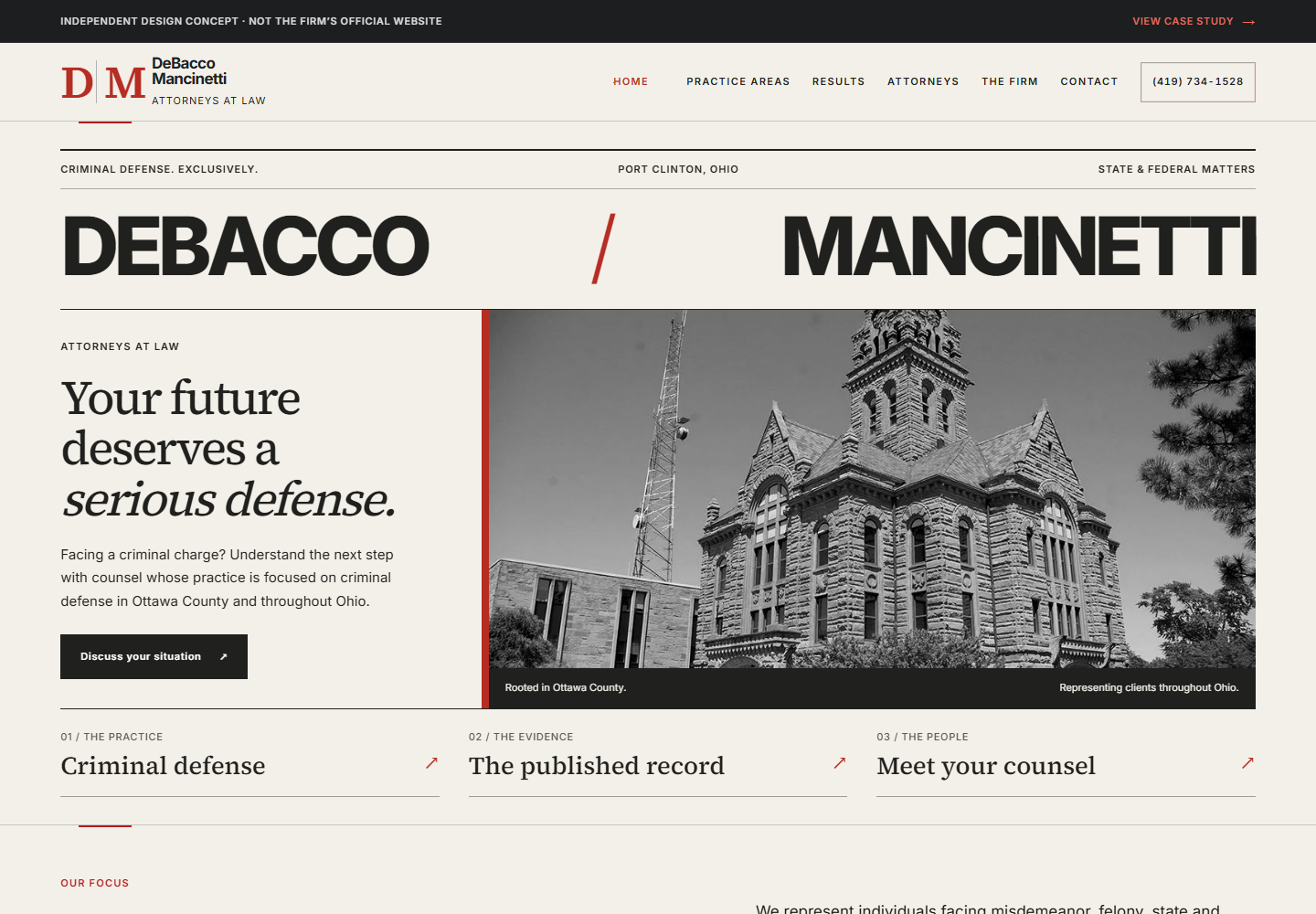
The firm already had the substance: a criminal-defense focus, attorney biographies, a substantial historical archive and a Port Clinton base. The design turns those particular strengths into an editorial identity: a firm-name masthead, documentary photography and a record that can be explored.
WorkResearch · Design · Front-end implementation
ByAdam Thomas Janes
StatusIndependent concept · October 2026 editorial direction
01 / The strategy
Begin with the person.
Support with the record.
A prospective client may arrive worried about a charge, a court date or what happens next. The homepage now connects that concern to a clear contact route and a focused practice overview. Historical evidence supports the decision without asking visitors to read an entire archive first.
The architecture stays deliberately compact: Practice Areas, Results, Attorneys, The Firm and Contact. Four substantive practice destinations connect the issue someone faces with relevant historical work. The Firm gathers press, client perspectives and trial media into a secondary path.
Biographies, historical outcomes and sources remain accessible with their qualifications.
A clear contact page distinguishes a real inquiry from the non-submitting design preview.
02 / Identity & typography
A practice with
its own point of view.
The red DM identity connects the concept to the existing practice. A wide Inter masthead gives the firm names visual weight. Source Serif 4 brings a more personal voice to names, quotations and selected reading moments. Paper surfaces, fine rules and indexed entries take their cues from an editorial publication.
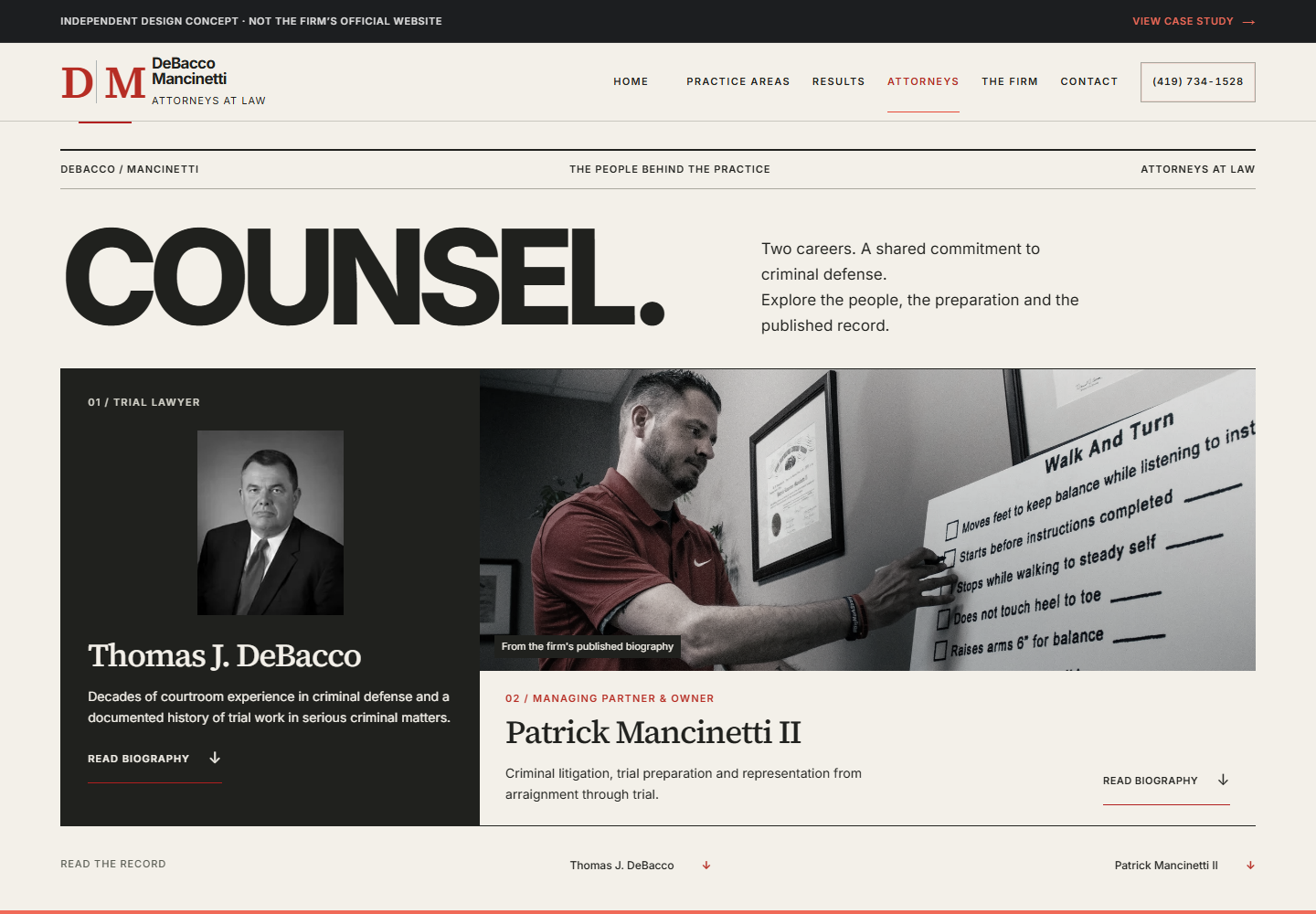
Each cover responds to its content: a photographic homepage, an attorney spread, a numbered practice index, an archive ledger, a continuity timeline and a direct contact panel. This replaces the repeated two-line slogan and red final phrase. Deep red remains readable on paper; brighter red is reserved for dark surfaces.
Brand red#B62D24
Dark-surface accent#F06A58
Cream#F3F0E9
Inter
Strong mastheads and page titles; quieter weights for paragraphs, factual detail and navigation. Scale and placement establish hierarchy.
Source Serif 4
Names, quotations and selected editorial moments contrast with the structural sans serif. Both families are bundled locally.
03 / Credibility in the details
The distinction between
atmosphere and evidence.
Authentic archived attorney photographs replace synthetic portraits. Illustrative shoreline, preparation and interior images are labeled as concept imagery. They establish a visual direction but are not presented as photographs of the firm’s premises or cases.
The firm’s current website supports the contact details and principal biography milestones. Selected Ohio court materials corroborate specific appellate work. Historical records remain attributed to their sources; neither a favorable result nor an attorney biography becomes a guarantee of another outcome.
71 migrated result entries, 18 press records and the attorney case histories remain available. Entries are not claimed to be 71 distinct cases.
Conflicting counts in one 2008 matter are documented rather than silently reconciled. Production legal copy still needs attorney approval.
Visible disclosure, noindex metadata and a form with no submission endpoint separate this work from the authorized firm website.
04 / Market position
Distinctive enough
to be remembered.
The reference covers below show several approaches in the local and regional market: attorney portraiture, courthouse imagery, service-led headlines and prominent consultation prompts. These are observations about the captured pages, not judgments about the quality of legal representation.
For DeBacco / Mancinetti, the opportunity is to make its particular history easier to recognize: a restrained red identity, a clear editorial hierarchy, genuine attorney imagery and connected case material. The result should feel specific to this practice while remaining straightforward to use.
Reference covers
The market at a glance.
Captured August 28, 2026. Each image links to the page represented. Live sites may have changed since capture.


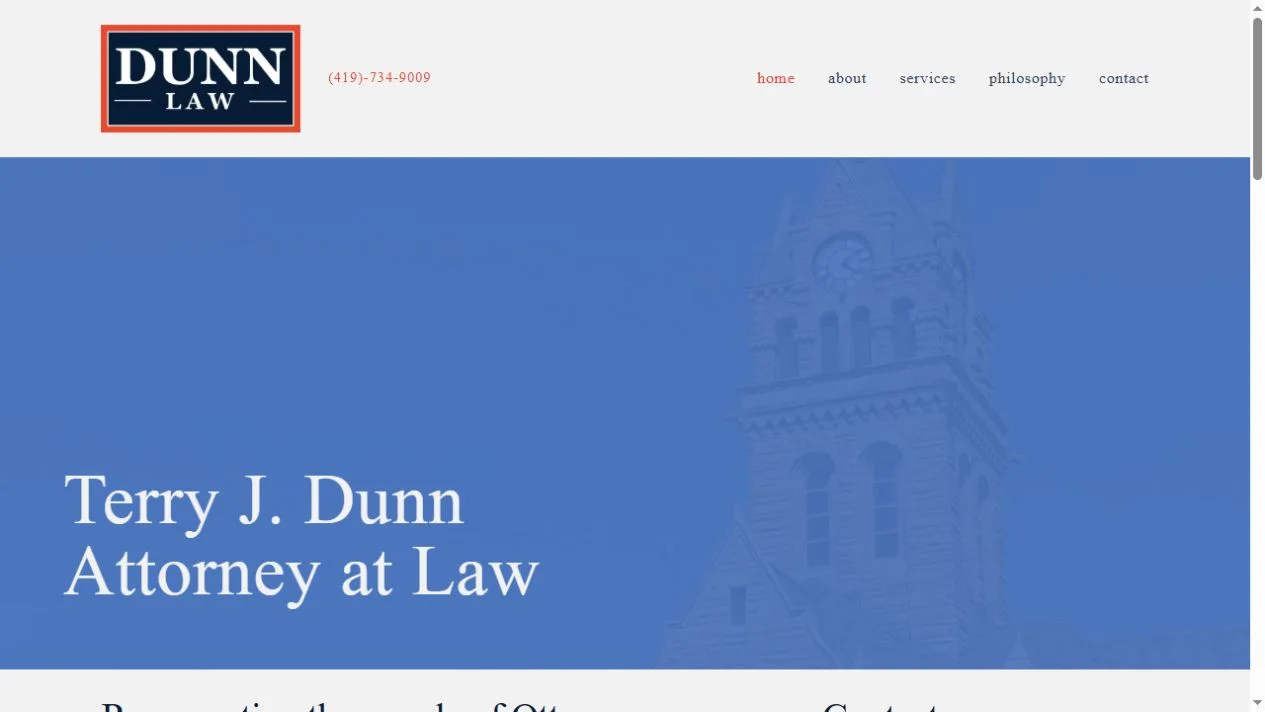
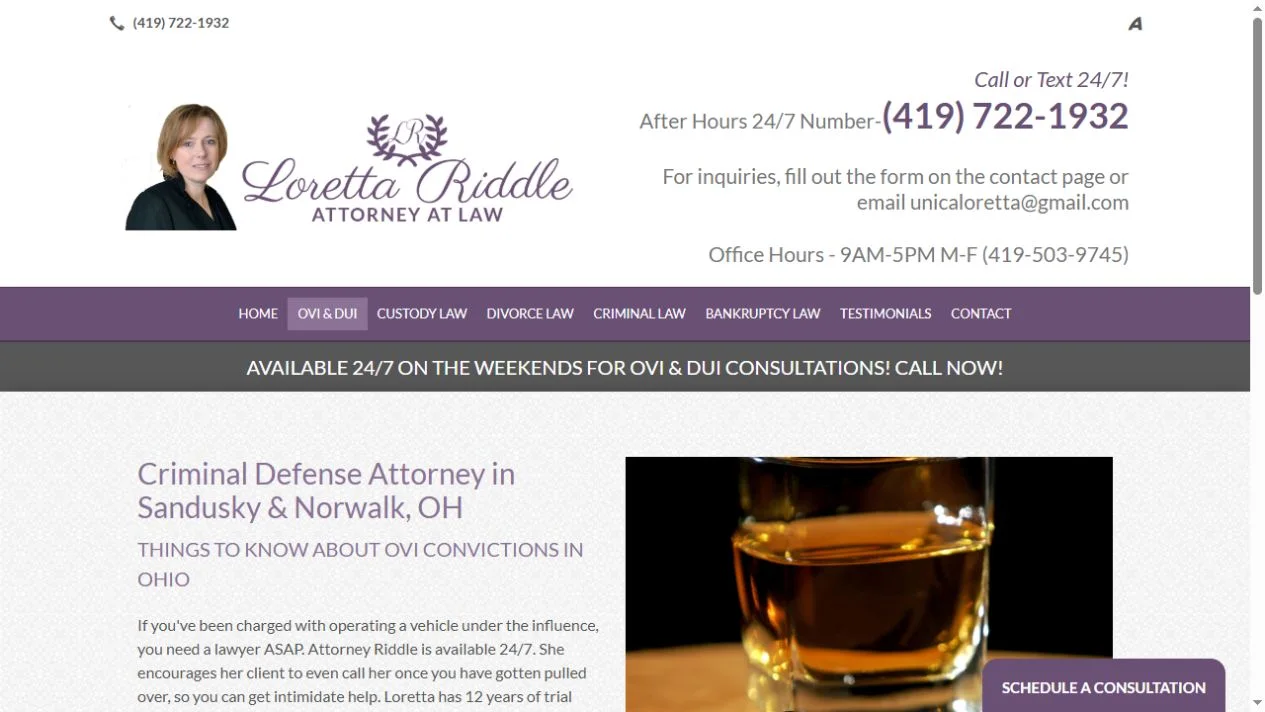
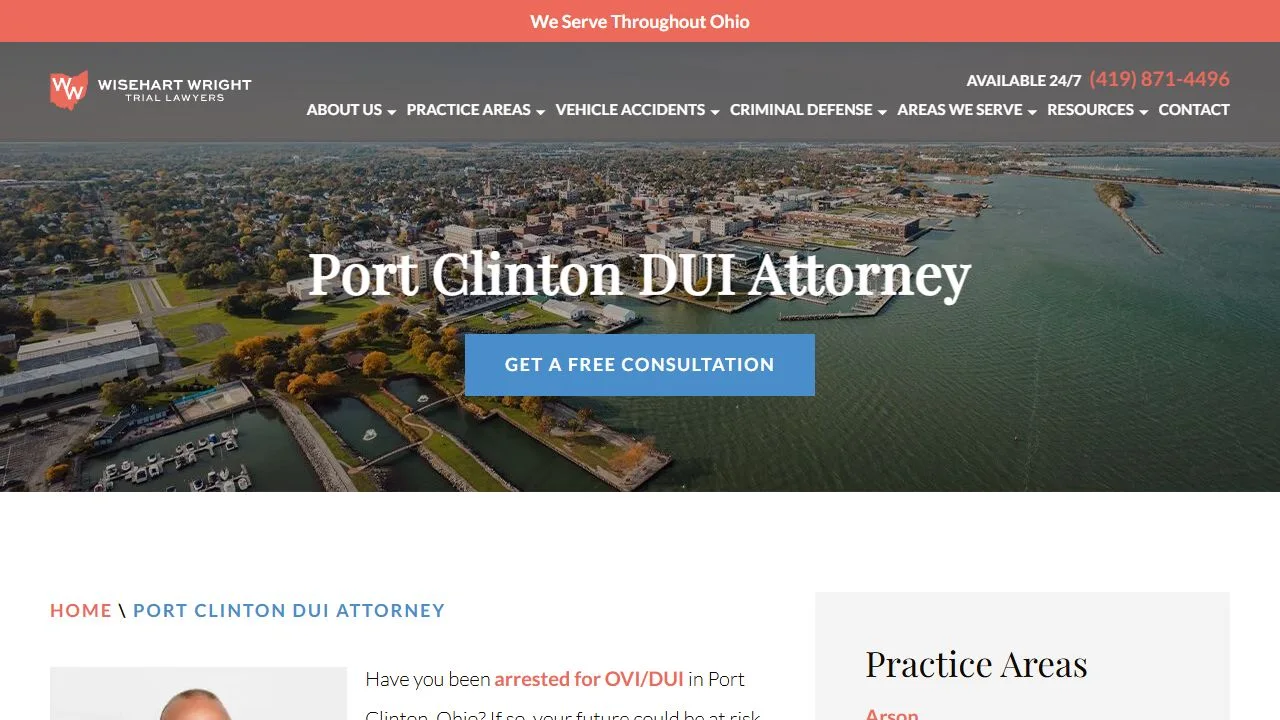
Third-party websites are reproduced for this attributed design comparison. Marcinko Law ↗ was also considered; no screenshot was captured because its certificate failed validation on the capture date. This is not a claim about its current availability.
05 / Implementation & validation
Refinement that can
be inspected.
The inherited HTML, CSS and JavaScript architecture is preserved. The refinement unifies repeated menu logic, removes duplicate contact docks, makes archive filters announce their state and keeps the contact preview from submitting data even if JavaScript is unavailable.
Seven viewport sizes cover 360 to 1920 pixels. The local QA checks rendered layouts, assets, document structure and automated WCAG rules. Separate interaction checks exercise navigation, filtering, keyboard focus and the contact preview. Automated checks supplement visual inspection; they are not a full accessibility certification.
Essential rendering no longer depends on remote image hosts or Google Fonts requests.
Fourteen converted source images total 1.77 MB versus 12.74 MB before conversion. This measures those files, not a claimed page-speed score.
All 133 page/viewport checks and 146 interaction/structure assertions passed on October 9, 2026.
Read QA results →06 / Presentation readiness
A considered concept.
A defined next step.
The demonstration is ready to review as a design proposal, with the recorded QA gates complete. It is not an authorized firm launch. Attorney review of historical wording, legal copy, source permissions and final photography remain necessary before production use.
The presentation begins with the homepage, follows a practice topic to its supporting record, then introduces the attorneys and the contact path. This case study explains the decisions behind that experience without turning the client demonstration into a development log.
Primary research: firm website, Thomas DeBacco biography, Patrick Mancinetti biography, historical results and contact details. Verification notes and source limitations are recorded in the source register.
07 / Search & AI discoverability
Distinctive to people.
Understandable to search.
The search foundation connects the same evidence a person needs: a clearly identified Port Clinton practice, complete attorney names, focused service pages and a historical record with source links. Unique page titles, descriptions, canonical URLs and factual structured data make those relationships explicit without flattening the editorial design into repeated keyword headlines.
Important content and links are present in the initial HTML, including the full archive. They do not require an AI system or search crawler to operate a menu or search widget. Descriptive links connect service questions to relevant attorneys, historical entries and court records. These are foundations for discovery and accurate citation—not a promise of rankings, recommendations or new clients.
Page-specific metadata, a consistent URL pattern, accessible HTML and a repeatable SEO check support a maintainable launch.
Firm, attorney and service relationships are described with structured data. No fabricated ratings, credentials, office locations or legal authorship are added.
The independent concept remains noindex. A separate launch plan provides a candidate sitemap and legacy-route mapping for approval on the firm's authorized domain.
Approach informed by Google's generative-AI search guidance and Bing's webmaster guidelines. An optional llms.txt index supplies context for tools that choose to read it; it is not a Google ranking mechanism.